Iowa Law Guide • Updated July 2026
Iowa's New Radon Law Is in Effect.
House File 2297 took effect July 1, 2026. Every new single- and two-family home built in Iowa must now include a passive radon mitigation system. Here's what the law does — and doesn't — do.
Test Your Home's Radon LevelWhat HF 2297 Requires
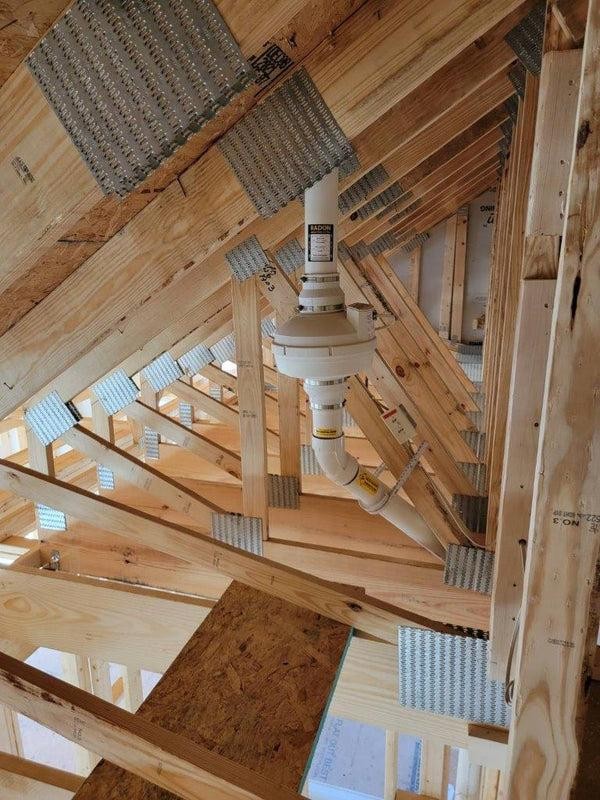
On May 19, 2026, Governor Kim Reynolds signed House File 2297 into law. It requires every newly constructed single-family or two-family residence in Iowa to include a passive radon mitigation system — a sealed pipe running from the gravel beneath the foundation up through the roof, venting radon gas by natural airflow, with no fan.
The law works through the state building code: it directs the Iowa state building code commissioner to adopt the passive radon requirement statewide, and requires local governments to adopt and enforce it. Before HF 2297, radon-resistant construction rules were a patchwork of local ordinances — now the requirement is uniform across all of Iowa.
The bill passed with near-unanimous bipartisan support — unanimous in the Iowa Senate, with only three votes against in the House. In the highest-radon state in the country, this wasn't controversial.
Key Dates
- May 19, 2026HF 2297 signed into law by Governor Reynolds.
- July 1, 2026The law takes effect statewide.
- Going forwardThe requirement applies to new construction commencing after the building code commissioner adopts it into the Iowa state building code. Your local building authority can confirm how it's being enforced in your jurisdiction.
What the Law Does Not Do
Three common misunderstandings about HF 2297, cleared up.
It doesn't touch existing homes.
HF 2297 applies to new construction only. If your home was built before the requirement, nothing changes — and the only way to know your radon level is still to test.
It doesn't require a fan.
The law requires a passive system — no fan, no electricity. Passive systems reduce radon by roughly 30–50%, which in Iowa's high-radon soil often isn't enough on its own. An active fan upgrade is what guarantees low levels.
It doesn't mandate testing.
No Iowa law requires a radon test — not HF 2297, and not the real estate disclosure law (Iowa Code 558A), which only requires sellers to disclose results if testing was done. Testing remains your choice, and your responsibility.
Buying a New Home After July 2026?
Your new home will come with the passive pipe already in the walls — that's the good news, and it makes fixing radon far cheaper than in an older home. But a passive stub is a head start, not a guarantee. A brand-new home on Iowa's glacial soil can test just as high as one built decades ago.
Test within your first 90 days of occupancy. If levels come back elevated, activating the system is a clean, one-visit job: we mount a continuous-duty fan on the existing pipe and retest until your home is below 2.7 pCi/L — guaranteed.
Passive vs. Active — the Homeowner's Guide →Building in Iowa?
HF 2297 compliance is now part of every central Iowa build. All Midwest Radon partners with builders to design passive systems correctly from the ground up — proper pipe routing, roof termination, and an attic outlet ready for future activation — so the system passes inspection and protects your buyers.
We also offer post-occupancy testing programs for your buyers, so your homes don't just comply with the law — they demonstrably work.
Builder Partnership Program →HF 2297 — Common Questions
Does HF 2297 apply to existing Iowa homes?
No. HF 2297 applies only to newly constructed single-family and two-family residences. It does not require anything of existing homes. If you own an older home, professional testing is still the only way to know your radon level.
Does the new law require an active radon system with a fan?
No. HF 2297 requires a passive radon mitigation system — pipes and venting with no fan. Passive systems typically reduce radon by only 30% to 50%, which in Iowa’s high-radon soil is often not enough to bring a home below the EPA action level of 4.0 pCi/L. Testing after move-in tells you whether the passive system needs to be activated with a fan.
Does Iowa law require a radon test when a home is bought or sold?
No. Iowa Code Chapter 558A is a disclosure law, not a testing mandate. A seller who has had the home tested must disclose the results and describe any mitigation work, but no law requires the test itself. In practice, that means the responsibility to test usually falls on the buyer.
When does the passive-system requirement actually take effect for my build?
The law took effect July 1, 2026. It directs the state building code commissioner to adopt the passive radon requirement into the Iowa state building code, and it applies to new construction commencing after that adoption. Check with your local building authority for how the requirement is being enforced in your jurisdiction.
The law covers the pipe. Testing covers your family.
Whether your home is brand new or a century old, a certified test is the only way to know what you're breathing.